
A sudden mechanical problem can put a commercial truck, its driver, cargo, and delivery schedule at risk. Emergency truck repair becomes necessary when a vehicle has a serious fault that affects safe operation or could quickly lead to a complete breakdown. Some problems develop with little warning. Others start with a dashboard light, a new noise, slow cranking, low air pressure, or a rising temperature gauge.
Knowing when to stop and request help is part of professional vehicle operation. Drivers, owner-operators, and fleet managers in Memphis, TN, Olive Branch, MS, and surrounding communities across Tennessee, Mississippi, and Arkansas should take critical symptoms seriously. Continuing to drive with unsafe brakes, steering, tires, air pressure, or other essential vehicle problems can create far greater damage and safety risks.
What Qualifies as an Emergency Truck Repair Situation?
An emergency repair situation is not limited to a truck that has already stopped moving. It can include any condition that makes operation unsafe, creates an immediate risk of a breakdown, or may cause serious damage if the truck remains in service.
Examples include severe engine overheating, major fluid leaks, low or unstable air pressure, brake trouble, tire damage, steering concerns, sudden power loss, a no-start condition, electrical failures, or a truck entering a severe derate. Trailer issues can also require urgent attention, particularly when they involve brakes, air lines, lights, suspension, tires, or the tractor-to-trailer connection.
The best response depends on the problem and the truck’s location. In some cases, a mobile truck repair technician may be able to inspect or repair the issue where the truck is parked. In other cases, towing or shop repair may be the safer option. Mobile repair availability depends on the vehicle condition, repair needed, service location, and site safety.
1. The Truck Will Not Start or Has Serious Engine Trouble
A truck that will not start can leave a driver stranded at a shipper, truck stop, customer site, or terminal. Common symptoms include clicking when the key is turned, slow cranking, no cranking, hard starting, rough idle, stalling, or warning lights appearing on the dash.
The cause may involve weak batteries, loose or corroded battery connections, a faulty starter, alternator trouble, damaged wiring, fuel delivery concerns, sensor faults, or an engine-related problem. While some basic visual checks may be safe, drivers should not attempt improvised wiring repairs or work on high-current battery systems without the right training and tools.
Repeated cranking can drain batteries and make a diagnosis more difficult. If the truck has a no-start condition, document any warning messages, unusual sounds, recent repairs, and changes in vehicle behavior. This information helps a technician identify the likely source of the problem.
2. Brake or Air System Problems Require Immediate Attention
Air brakes are safety-critical. Low air pressure, a warning alarm, slow pressure buildup, pressure loss, or unusual hissing can indicate an air leak, damaged line, failing compressor, valve problem, brake chamber issue, or another air system fault.
A truck with unsafe brake operation or unstable air pressure should not continue operating. Do not bypass air brake safety systems, attempt temporary repairs with unsuitable materials, or crawl beneath an unsupported truck or trailer.
Critical brake and air system warnings
Watch for these signs:
- Low-air warning lights or audible alarms
- Air pressure gauges that fail to reach normal operating range
- Pressure dropping quickly after the engine is shut down
- Parking brakes that will not release properly
- Changes in braking response or pulling during braking
- Hissing near air lines, fittings, glad hands, or brake components
- Damaged, loose, or hanging hoses
An emergency truck repair call may be appropriate when the truck is safely parked and the condition can be assessed on-site. A qualified technician can inspect air lines, fittings, brake components, compressor performance, and related systems to determine the right repair path.
3. The Engine Is Overheating or Losing Coolant
A rising temperature gauge is a warning that should never be ignored. Heavy-duty diesel engines generate substantial heat, especially during hot weather, long grades, heavy hauling, stop-and-go traffic, and extended idling. But operating conditions often expose a cooling-system fault that already exists.
Overheating may be related to low coolant, leaking hoses, radiator damage, restricted airflow, water pump trouble, a faulty cooling fan, belt damage, thermostat issues, or internal engine concerns. Steam, coolant odor, visible leaks, engine derates, or a high-temperature warning call for prompt action.
If the temperature climbs beyond its normal range, reduce engine load and pull over safely as soon as possible. Shut down if the temperature continues rising. Never open a hot radiator cap or pressure cap. Hot coolant and steam can cause severe burns. Do not pour cold water into an overheated engine or attempt repairs around hot belts, fans, and engine components.
4. Electrical Faults and Battery Problems Can Become a Roadside Breakdown
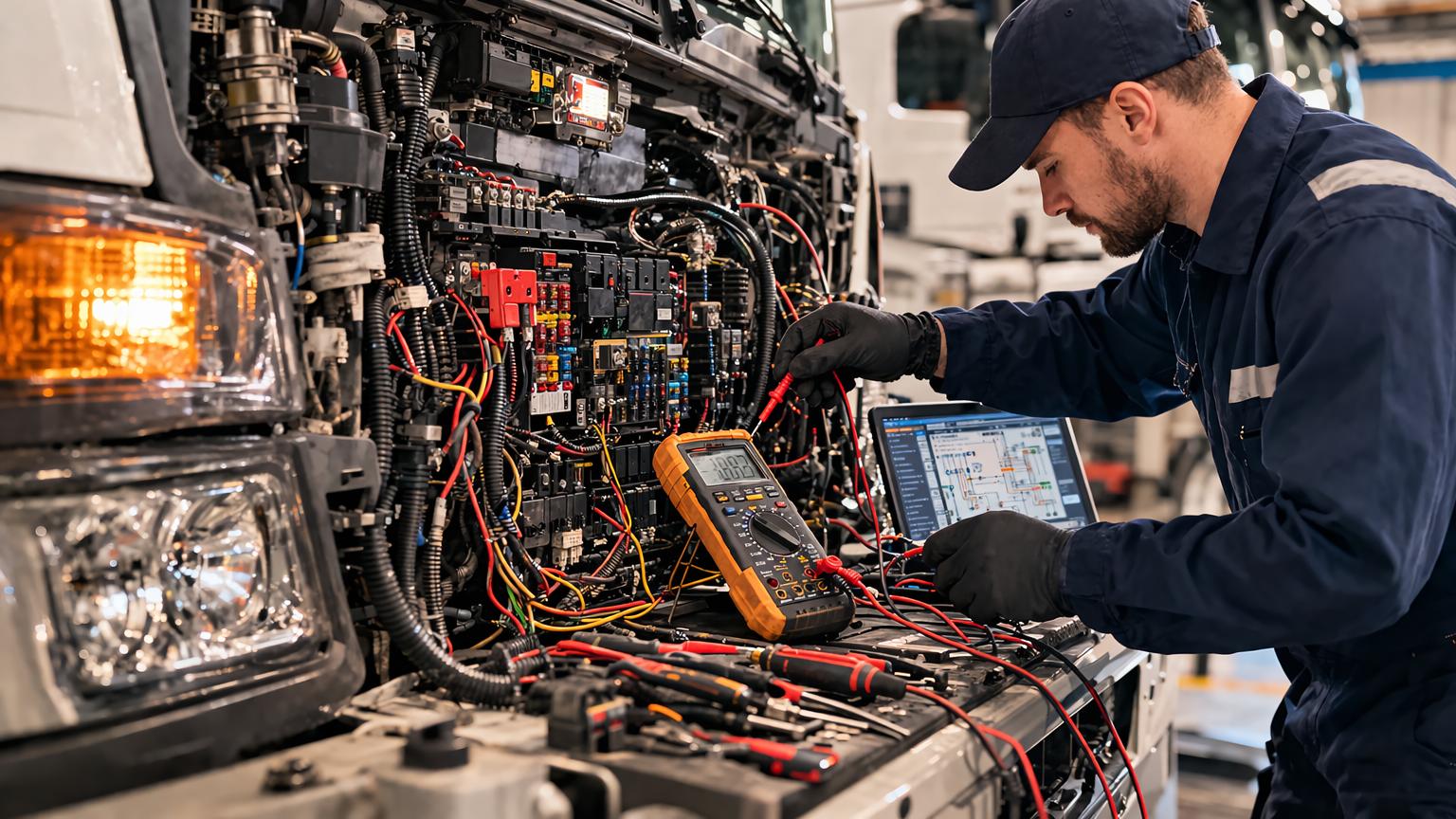
Electrical problems can affect far more than starting. Commercial trucks depend on batteries, alternators, cables, grounds, fuses, relays, sensors, control modules, and wiring harnesses. A fault in any of these areas may cause warning lights, intermittent operation, charging problems, loss of lights, no-start conditions, or false sensor readings.
Signs that need attention include dim lights, frequent jump-starts, battery warnings, burned odors, flickering dash displays, intermittent accessories, repeated blown fuses, or charging-system messages. A battery that appears to be the problem may only be showing the effects of a failing alternator, poor ground, damaged cable, or electrical drain.
An emergency truck repair technician can use diagnostic testing to assess battery condition, charging voltage, cable connections, grounds, and related electrical circuits. This reduces the risk of replacing parts based on assumptions.
5. Warning Lights, Engine Derates, and Aftertreatment Faults Should Not Be Dismissed
A check engine light does not identify one specific failure, but it means the truck’s control system detected a condition that needs attention. The cause may relate to an engine sensor, fuel system, boost issue, electrical circuit, cooling concern, DEF system, DPF, SCR system, or another aftertreatment component.
A truck may begin with a steady warning light and later develop reduced power, regeneration messages, increased fuel use, or a derate. A derate limits performance to protect the truck or respond to an emissions-related fault. It can leave the truck unable to maintain speed or pull a normal load.
Clearing a fault code does not repair the condition that caused it. If the underlying issue remains, the code may return, the derate may worsen, and the truck may become more difficult to operate.
When to stop and request diesel diagnostics
Safely stop and seek professional help if warning lights are accompanied by severe power loss, a stop-engine message, overheating, smoke, leaks, unusual engine noises, or a rapidly worsening derate. Mobile diesel diagnostics may help retrieve codes, review live system data, and identify whether the truck needs an on-site repair or more extensive service.
6. Trailer Air Leaks, Brake Problems, and Electrical Faults Can Stop the Entire Combination
The trailer is not separate from the safety of the load. A damaged trailer air line, leaking glad hand, faulty brake chamber, electrical problem, failing light, or suspension concern can interrupt operation just as quickly as a tractor issue.
Trailer problems may include air loss, brake drag, improper brake response, damaged electrical plugs, intermittent marker lights, failed brake lights, worn tires, broken suspension components, or unsafe landing gear. A trailer with defective brakes, severe tire damage, unstable suspension, or critical lighting issues may need repair before returning to service.
Drivers should inspect trailer connections before departure and after coupling. Check for damaged air lines, loose electrical connections, leaks, wires that drag or stretch, and lights that do not function correctly. Do not use makeshift repairs for brake, air, or electrical systems.
7. Tires, Steering, Suspension, and Wheel-End Problems Must Not Wait
A damaged tire, steering issue, failed suspension component, or overheated wheel end can become dangerous quickly. Commercial vehicles carry heavy loads, and a small defect can create handling problems, blowouts, cargo instability, or more extensive axle and suspension damage.
Warning signs include pulling to one side, vibration, uneven tire wear, low tire pressure, bulges, exposed cords, smoke, excessive wheel-end heat, fluid around hubs, broken suspension parts, or a vehicle that sits unevenly.
Trucks with unsafe tire, steering, suspension, or wheel-end conditions should not continue operating. Move to a safe location if possible, secure the vehicle, and request professional help. Avoid touching hot wheel-end components, and do not work under a vehicle without proper support.
What Drivers Should Do During a Diesel Truck Breakdown
A calm, safety-first response protects the driver and helps speed up the repair process.
First, move the truck to a safe location if it can be done without increasing risk. Activate hazard lights, follow applicable roadside safety requirements, and keep a safe distance from traffic. Set the parking brake and secure the vehicle as appropriate for the situation.
Next, note what happened. Record dashboard messages, fault codes, gauge readings, unusual noises, visible leaks, and changes in performance. Share the truck’s location, make, model, engine information if available, trailer details, and recent service history when contacting a repair provider.
Do not continue operating a truck with unsafe brakes, steering, tires, severe overheating, major leaks, or other critical problems. Do not attempt unsafe roadside repairs involving hot engines, pressurized systems, electrical circuits, moving parts, or air brake components.
How Preventive Maintenance Reduces Emergency Repairs
Not every breakdown can be avoided, but scheduled maintenance helps identify developing problems earlier. Battery and charging checks, air-system inspections, brake service, tire monitoring, cooling-system evaluations, fluid checks, belt inspections, diesel diagnostics, and aftertreatment service all contribute to better vehicle reliability.
Fleet managers should track recurring warning lights, air leaks, battery failures, DPF messages, tire wear, and repeat repairs. Patterns often reveal a problem before it sidelines another truck. Drivers should report new symptoms promptly rather than waiting for a warning to become a full breakdown.